
Introduction
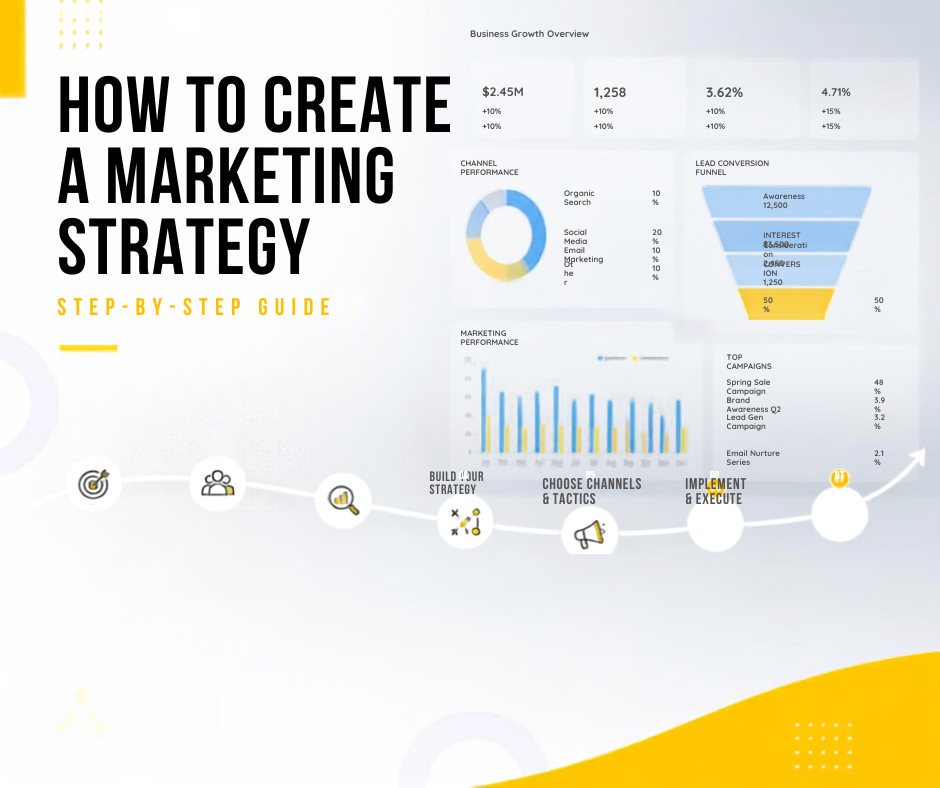
A successful business rarely grows by accident. Behind most sustainable businesses is a clear marketing strategy that identifies who the business serves, what it offers, how it reaches customers, and how success will be measured.
Whether you’re launching a new business, promoting an existing company, building a personal brand, or marketing a digital product, a well-designed marketing strategy gives you a clear direction.
In this guide, you’ll learn how to create a comprehensive marketing strategy step by step.
What Is a Marketing Strategy?
A marketing strategy is a structured plan that explains how a business will attract, engage, convert, and retain its target customers.
It brings together several important elements, including:
- Market research
- Target audience
- Competitor analysis
- Marketing objectives
- Brand positioning
- Marketing channels
- Content strategy
- Advertising
- Budget
- Performance measurement
A strategy answers one fundamental question:
How will we consistently reach the right people and turn them into customers?
Marketing Strategy vs. Marketing Plan
These terms are often confused.
Marketing Strategy
Defines the overall direction.
It answers:
Who are we targeting?
What problem are we solving?
Why should customers choose us?
Where will we compete?
Marketing Plan
Defines how the strategy will be executed.
It answers:
What will we do?
When will we do it?
Who will do it?
How much will it cost?
A strategy provides the direction; the plan turns that direction into action.
Step 1: Understand Your Business
Before marketing your business, understand what you’re actually selling.
Define:
Your Product or Service
What exactly are you offering?
The Problem You Solve
What problem does your product or service solve?
Your Unique Value
Why should someone choose you instead of another option?
Your Business Model
How does the business make money?
For example:
Product → Customer → Purchase → Revenue
or:
Free Content → Audience → Trust → Paid Service
A strong marketing strategy begins with a clear understanding of the business itself.
Step 2: Conduct Market Research
Never build your marketing strategy entirely on assumptions.
Research your market.
Study:
- Market demand
- Customer behavior
- Industry trends
- Competitors
- Pricing
- Customer complaints
- Existing solutions
- Emerging opportunities
Look for gaps.
Ask:
What are customers currently struggling with that businesses aren’t solving well?
That gap may become your competitive opportunity.
Step 3: Define Your Target Audience
You cannot effectively market to everyone.
Define the people most likely to need and purchase your product.
Consider:
- Age
- Location
- Profession
- Income
- Education
- Interests
- Problems
- Goals
- Buying behavior
- Online behavior
Instead of saying:
“Our customers are everyone.”
Be specific.
For example:
“Our primary audience is young African entrepreneurs who want to use digital tools to grow their businesses.”
The more clearly you understand your audience, the easier it becomes to create relevant marketing.
Step 4: Create Customer Personas
A customer persona is a realistic representation of your ideal customer.
For example:
Persona: Sarah
Age: 27
Occupation: Small business owner
Location: Yaoundé
Goal: Increase online sales
Problem: Doesn’t understand digital marketing
Preferred platforms: Facebook, WhatsApp, Instagram
Buying concern: Price and trust
Now your marketing team can create campaigns specifically for Sarah rather than an imaginary “general customer.”
Step 5: Analyze Your Competitors
Identify your major competitors.
Study:
- Their products
- Pricing
- Branding
- Websites
- Social media
- Content
- Advertising
- Customer reviews
- Strengths
- Weaknesses
Don’t simply copy them.
Instead ask:
What can we do differently or better?
You might discover an opportunity through:
- Better customer service
- Better pricing
- Better content
- Faster delivery
- Better user experience
- Stronger branding
- A more specific niche
Step 6: Define Your Unique Selling Proposition
Your Unique Selling Proposition (USP) explains why customers should choose you.
A strong USP should communicate:
What you offer + Who it’s for + Why you’re different
For example:
“Practical digital skills training designed to help African entrepreneurs build real online businesses.”
Your USP should be simple enough for customers to understand quickly.
Step 7: Set SMART Marketing Goals
Your marketing strategy needs measurable objectives.
Instead of:
“We want more customers.”
Set a measurable goal such as:
“Generate 500 qualified website visitors and 50 new leads within 90 days.”
SMART goals are:
- Specific
- Measurable
- Achievable
- Relevant
- Time-bound
Possible marketing goals include:
- Increase website traffic
- Generate leads
- Increase sales
- Improve brand awareness
- Grow social media engagement
- Increase email subscribers
- Improve customer retention
Step 8: Choose Your Marketing Channels
You don’t need to use every marketing channel.
Choose the channels where your target audience is most active.
Possible channels include:
Search Engines
- Bing
Social Media
- TikTok
- X
- YouTube
Direct Marketing
- SMS
Content Marketing
- Blog
- Video
- Podcasts
- E-books
- Tutorials
Paid Advertising
- Search advertising
- Social media advertising
- Display advertising
The best channel isn’t necessarily the most popular one.
It’s the one that effectively reaches your audience.
Step 9: Build Your Content Strategy
Content marketing helps you attract people before asking them to buy.
Create content around your audience’s:
Problems
Questions
Goals
Interests
For example, a digital marketing company might publish:
- How to create a Facebook business page
- How to improve Instagram engagement
- How to create a marketing funnel
- How to run your first online advertisement
Your content should provide value while gradually introducing your products and services.
Step 10: Create a Content Calendar
Consistency matters.
Create a calendar showing:
| Day | Content | Platform | Goal |
|---|---|---|---|
| Monday | Educational article | Blog | Traffic |
| Tuesday | Short video | Awareness | |
| Wednesday | Tutorial | YouTube | Education |
| Thursday | Customer story | Trust | |
| Friday | Promotional post | Sales | |
| Saturday | Tips | Engagement |
Your calendar doesn’t need to be complicated.
The objective is to ensure that your marketing activities are planned rather than random.
Step 11: Build Your Marketing Funnel
A marketing funnel describes how someone moves from discovering your business to becoming a customer.
Stage 1 — Awareness
People discover you.
Content → Social Media → Search → Advertising
↓
Stage 2 — Interest
They become interested.
Website → Videos → Articles → Lead Magnet
↓
Stage 3 — Consideration
They evaluate your offer.
Reviews → Testimonials → Demonstrations → Comparison
↓
Stage 4 — Conversion
They purchase.
Offer → Sales Page → Checkout → Customer
↓
Stage 5 — Retention
You continue serving them.
Email → Support → Community → New Offers
A good marketing strategy doesn’t stop at the first sale.
Step 12: Develop Your Brand Strategy
Your marketing becomes stronger when people recognize your brand.
Define:
- Brand identity
- Logo
- Colors
- Typography
- Tone of voice
- Messaging
- Visual style
More importantly, establish what you want people to associate with your brand.
For example:
AfTech Digital → Technology + Education + Digital Business
Consistency builds recognition.
Step 13: Create Your Marketing Budget
Your strategy must fit your financial resources.
Your budget might include:
- Advertising
- Content creation
- Website
- Software
- Graphic design
- Video production
- Influencer marketing
- Email marketing
- SEO
- Marketing staff
Don’t simply ask:
“How much should we spend?”
Ask:
“What return are we expecting from this investment?”
Step 14: Launch Your Marketing Campaign
Once everything is prepared, execute the strategy.
Start with a controlled campaign.
Monitor:
- Reach
- Engagement
- Website visits
- Leads
- Sales
- Conversion rate
- Cost per lead
- Customer acquisition cost
Don’t immediately spend your entire budget.
Test first.
Step 15: Measure Your Results
You cannot improve what you don’t measure.
Important marketing metrics include:
Website Traffic
How many people visit your website?
Conversion Rate
What percentage of visitors take the desired action?
Cost Per Lead
How much does it cost to generate one lead?
Customer Acquisition Cost
How much does it cost to acquire one customer?
Return on Investment
How much revenue does your marketing generate compared with what you spend?
Customer Retention
How many customers return?
Step 16: Test and Optimize
Marketing is rarely perfect on the first attempt.
Test different:
- Headlines
- Images
- Videos
- Offers
- Audiences
- Landing pages
- Calls-to-action
- Advertising messages
For example:
Campaign A: “Learn Digital Marketing”
Campaign B: “Get More Customers Online”
If Campaign B generates better results, you have learned something about what your audience responds to.
This process is called optimization.
Step 17: Create a Customer Retention Strategy
Getting a customer is only part of the job.
Keeping them can be even more valuable.
Use:
- Excellent customer service
- Follow-up messages
- Email marketing
- Loyalty programs
- Exclusive offers
- Useful educational content
- Customer communities
- Personalized communication
A satisfied customer can become:
Repeat customer + Referral source + Brand advocate
A Simple Marketing Strategy Framework
You can summarize your entire strategy using this framework:
1. Research
Where are we now?
↓
2. Audience
Who are we targeting?
↓
3. Positioning
Why should they choose us?
↓
4. Objectives
What do we want to achieve?
↓
5. Channels
Where will we reach them?
↓
6. Content
What will we communicate?
↓
7. Campaign
How will we execute it?
↓
8. Measurement
What happened?
↓
9. Optimization
What should we improve?
Common Marketing Strategy Mistakes
Trying to Reach Everyone
A broad audience often produces weak messaging.
Focusing Only on Social Media
Your business should ideally have assets you control, such as your website and customer database.
Creating Content Without a Goal
Every major piece of content should have a purpose.
Ignoring Data
Don’t rely entirely on assumptions.
Copying Competitors
Learn from competitors, but build your own advantage.
Changing Strategy Too Frequently
Give campaigns enough time to generate meaningful data.
Focusing Only on New Customers
Customer retention deserves attention too.
Marketing Strategy Example
Imagine you operate an online training business.
Your strategy might look like this:
Target audience: Young professionals and entrepreneurs
Problem: Lack of practical digital skills
Solution: Affordable online technology training
USP: Practical, project-based learning
Channels: Google, Facebook, YouTube, WhatsApp
Content: Tutorials, guides, case studies
Lead magnet: Free digital marketing guide
Conversion: Course offer
Retention: Community + advanced courses
Goal: Generate 100 qualified leads per month
Measurement: Leads, conversion rate, sales and customer acquisition cost
Now the marketing activity has direction.
How Often Should You Review Your Marketing Strategy?
Don’t create your strategy once and forget about it.
Review your marketing performance regularly.
Weekly
Check:
- Campaign performance
- Engagement
- Leads
- Sales
Monthly
Analyze:
- Best-performing channels
- Content performance
- Advertising costs
- Conversion rates
Quarterly
Review the entire strategy.
Ask:
What is working?
What isn’t working?
What has changed in the market?
What should we stop?
What should we improve?
Where is the next opportunity?
Final Thoughts
A comprehensive marketing strategy is not simply a list of social media posts or advertisements.
It is a complete system for understanding your market, reaching the right audience, communicating your value, converting prospects into customers, and measuring the results.
The process can be summarized as:
Research → Audience → Positioning → Goals → Channels → Content → Campaign → Measurement → Optimization
You don’t need to start with a massive marketing budget.
Start with a clear audience, a valuable offer, a strong message and a measurable objective.
Then test, learn and improve.
Great marketing isn’t about reaching everyone. It’s about reaching the right people with the right message at the right time.
Build the strategy. Execute consistently. Measure everything. Improve continuously.