
Introduction
Software development is entering a new phase.
For decades, developers were expected to write most of the code themselves, understand programming languages deeply, debug applications manually, and spend significant amounts of time moving between editors, documentation, terminals, and development tools.
Artificial intelligence is changing that workflow.
In 2026, developers increasingly work alongside AI systems capable of generating code, analyzing repositories, fixing errors, creating tests, modifying multiple files, and carrying out development tasks with considerably less manual intervention.
Two concepts have become particularly important in this transformation:
Agentic Development and Vibe Coding.
Although they are related, they describe different approaches to working with AI.
What Is Agentic Development?
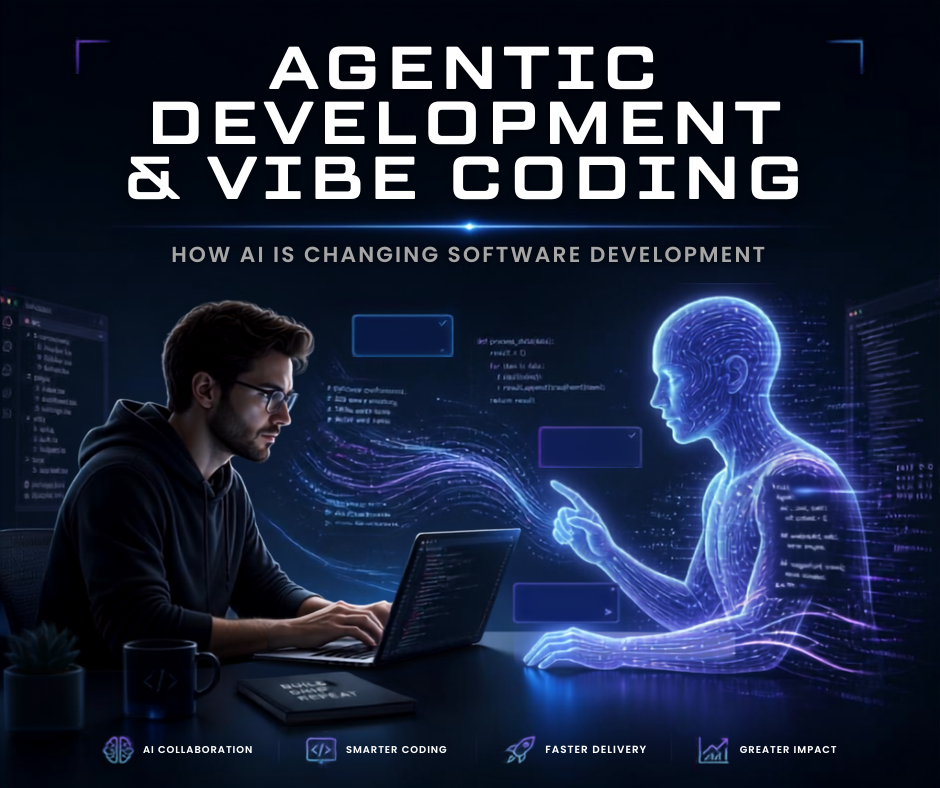
Agentic development refers to a software development workflow in which AI agents can independently perform multiple development tasks based on a developer’s instructions.
Instead of asking AI:
“Write this function.”
a developer might say:
“Add user authentication to this application, connect it to the existing database, create the required API endpoints, write tests, and fix any errors.”
An AI coding agent may then inspect the existing project, determine which files need modification, implement changes, run tests, identify problems, and iterate.
The developer becomes less of a person who manually writes every line and more of a technical supervisor, architect, reviewer, and decision-maker.
How Agentic Development Differs From Traditional AI Coding
Traditional AI-assisted programming usually looks like this:
Developer → Prompt → AI generates code → Developer copies/reviews code
Agentic development can look more like:
Developer → Defines objective → AI investigates → AI plans → AI modifies project → AI tests → AI fixes problems → Developer reviews
This represents a major shift.
The AI is no longer simply a code generator.
It becomes an active participant in the development workflow.
What Is Vibe Coding?
The term “vibe coding” became popular to describe a more conversational approach to software creation.
Instead of manually implementing every technical detail, the developer describes what they want in natural language and allows AI to generate much of the implementation.
For example:
“Create a modern dashboard where users can register, log in, view their transactions and download reports.”
The AI can generate the initial application structure, interface, components, database logic, and other implementation details.
The developer then evaluates the result and continues communicating changes:
“Make the dashboard cleaner.”
“Add dark mode.”
“Fix the mobile layout.”
“Add an export-to-PDF button.”
The process becomes highly iterative.
Vibe Coding Is Not Simply “Programming Without Coding”
This is an important distinction.
Vibe coding does not necessarily mean that programming knowledge has become useless.
In fact, the more complex the project becomes, the more important technical understanding can become.
Someone who understands:
- Programming logic
- Databases
- APIs
- Authentication
- Security
- Software architecture
- Debugging
- Testing
- Deployment
can usually get much more reliable results from AI than someone who simply accepts whatever code the AI produces.
AI can generate code quickly.
Understanding whether that code is correct is still a critical skill.
Why Agentic Development Is Growing
Several factors are driving the rise of agentic development.
1. AI Coding Models Are Becoming More Capable
Modern AI models can understand increasingly large amounts of code and project context.
They can reason across multiple files rather than treating every request as an isolated programming problem.
This makes them useful for larger development tasks.
2. Developers Want to Reduce Repetitive Work
Developers spend significant amounts of time on tasks such as:
- Writing boilerplate
- Creating tests
- Refactoring code
- Debugging
- Documentation
- Converting code
- Creating components
- Reviewing changes
AI agents can automate portions of these workflows.
That allows developers to spend more time thinking about architecture, product requirements, user experience, and business problems.
3. Natural Language Is Becoming a Development Interface
The traditional interface for programming is code.
Increasingly, developers are also interacting with development environments through natural language.
Instead of manually performing dozens of operations, a developer can describe the desired outcome.
This does not eliminate technical interfaces.
Instead, it creates another layer of abstraction between the developer and the underlying system.
The New Developer Workflow
A modern AI-assisted workflow can look like this:
Step 1 — Define the problem
Explain what the software needs to accomplish.
Step 2 — Let AI analyze the project
The agent examines the repository and existing architecture.
Step 3 — Create a plan
The AI determines which components need to change.
Step 4 — Implement
The agent modifies or creates the necessary code.
Step 5 — Test
Automated tests and development tools are used to identify problems.
Step 6 — Review
The developer examines the implementation.
Step 7 — Iterate
The developer provides additional instructions.
This creates a continuous loop:
Describe → Generate → Test → Review → Improve
What Happens to the Role of Developers?
AI isn’t simply changing how developers write code.
It is changing what developers spend their time doing.
The developer of the future may spend less time typing boilerplate code and more time on:
- System architecture
- Product thinking
- Problem solving
- Security
- Code review
- AI orchestration
- Testing
- Infrastructure
- User experience
- Business requirements
This means programming careers are likely to evolve rather than simply disappear.
Will AI Replace Programmers?
This is one of the biggest questions surrounding AI development.
The more realistic answer is:
AI is likely to automate parts of programming faster than it eliminates the need for programmers.
Simple coding tasks are particularly vulnerable to automation.
But complex software involves much more than writing syntax.
Someone still needs to understand:
What should we build?
Why are we building it?
How should the system be designed?
What security risks exist?
What happens when something fails?
How should the system scale?
How should users interact with it?
These are engineering questions.
The Importance of Software Engineering Becomes Greater
Ironically, the rise of AI coding may make software engineering principles even more important.
When AI can produce thousands of lines of code quickly, poorly designed systems can also be produced quickly.
Developers therefore need to understand:
- Architecture
- Design patterns
- Database design
- Security
- Version control
- Testing
- Performance
- Maintainability
- Scalability
The challenge is no longer simply:
“Can you write the code?”
It increasingly becomes:
“Can you build and validate the right system?”
The Risks of Vibe Coding
Vibe coding is powerful, but it has limitations.
1. AI Can Make Mistakes
AI-generated code can contain:
- Bugs
- Security vulnerabilities
- Incorrect assumptions
- Poor architecture
- Performance problems
Never assume generated code is automatically correct.
2. Developers Can Lose Understanding
If someone continuously accepts AI-generated code without understanding it, they may eventually struggle to debug or maintain the system.
This is particularly dangerous in production environments.
3. Security Can Become a Problem
AI-generated applications can accidentally introduce vulnerabilities involving:
- Authentication
- Authorization
- Input validation
- API keys
- Database access
- File uploads
- Data exposure
Security review remains essential.
Vibe Coding Is Excellent for Prototyping
One area where AI-assisted development is particularly powerful is rapid prototyping.
An entrepreneur can describe an idea and quickly create an early version.
For example:
“Build a platform where small businesses can register, create products and receive customer inquiries.”
AI can help produce a functional prototype much faster than traditional development alone.
The entrepreneur can then test the idea with real users before investing heavily in development.
AI Agents and the Future of Startups
This could significantly change how startups operate.
Previously, building software might require:
- Product manager
- UI/UX designer
- Frontend developer
- Backend developer
- Database specialist
- QA engineer
- DevOps engineer
AI tools cannot simply replace all of these roles today, but they can increasingly amplify a small team’s capabilities.
A small team can potentially build, test, and iterate products much faster.
This lowers some barriers to software entrepreneurship.
The Developer Becomes an AI Orchestrator
One emerging skill is AI orchestration.
The developer needs to know how to divide a large problem into smaller tasks and instruct AI systems effectively.
For example:
Task 1: Analyze database requirements.
Task 2: Design database schema.
Task 3: Create backend APIs.
Task 4: Build frontend interface.
Task 5: Add authentication.
Task 6: Write automated tests.
Task 7: Perform security review.
This is much closer to managing an intelligent development team than simply asking an AI chatbot for code snippets.
Skills Developers Should Learn in 2026
Developers shouldn’t respond to AI by abandoning programming.
Instead, they should become AI-enhanced developers.
Focus on:
Programming fundamentals
Understand logic, data structures, algorithms, and programming concepts.
Software engineering
Learn architecture, testing, version control, debugging, and maintainability.
AI-assisted development
Learn how to work effectively with coding agents and AI development environments.
Git and GitHub
Understand version control and collaborative development.
Databases
Learn SQL, database design, and data modeling.
APIs
Understand how modern applications communicate.
Cybersecurity
Learn how to identify and prevent vulnerabilities.
Cloud and DevOps
Understand deployment, containers, CI/CD, and infrastructure.
Product thinking
Understand the business problem behind the software.
A New Definition of a Good Developer
In the past, one measure of programming ability was:
How much code can you write?
The AI era may increasingly emphasize:
How well can you solve problems using code, AI, tools, and engineering principles?
A developer who can use AI but cannot understand the resulting system is limited.
A developer who understands engineering but refuses to use AI may also become less efficient.
The strongest combination is:
Human reasoning + engineering knowledge + AI assistance.
What Businesses Should Do
Businesses should not adopt AI coding tools simply because they are fashionable.
Instead, they should identify where AI can create measurable value.
Start with:
- Repetitive development tasks
- Documentation
- Testing
- Prototyping
- Internal tools
- Code refactoring
- Bug investigation
- Developer productivity
Then establish policies around:
- Security
- Code review
- Data privacy
- Intellectual property
- Testing
- Human approval
AI should accelerate engineering—not eliminate engineering discipline.
The Future: From Writing Code to Managing Intent
Perhaps the biggest change is the movement from code-first development toward intent-driven development.
Instead of spending most of the development process translating an idea into thousands of lines of code manually, developers increasingly describe:
What they want → AI determines implementation → Developer validates the result
This doesn’t make programming irrelevant.
It makes understanding the problem more important.
Final Thoughts
Agentic development and vibe coding represent more than another trend in programming.
They are part of a broader transformation in how humans interact with software development tools.
The developer is gradually moving from being purely a code producer toward becoming a:
Problem Solver → Architect → Reviewer → AI Orchestrator → Software Engineer
For beginners, this creates an exciting opportunity to build projects faster.
For experienced developers, it creates an opportunity to dramatically increase productivity.
But there is one principle worth remembering:
Don’t use AI to avoid learning software engineering. Use AI to become a better software engineer.
The developers who thrive in 2026 and beyond will likely not be those who compete with AI at typing code.
They will be those who know what to build, why to build it, how to guide AI, and how to verify that what was built is actually good.